Visiting Dolmabahçe Palace: practical tips
Where to go in, how the one-way route works, how long to allow, what to leave at the hotel, and how to get there by tram or ferry.
Published
Dolmabahçe is a single, very long building on the Bosphorus, and the visit is more structured than at most Istanbul sights. You walk a set route, you can’t easily double back, and a few small decisions before you arrive make the difference between a relaxed morning and a rushed one.
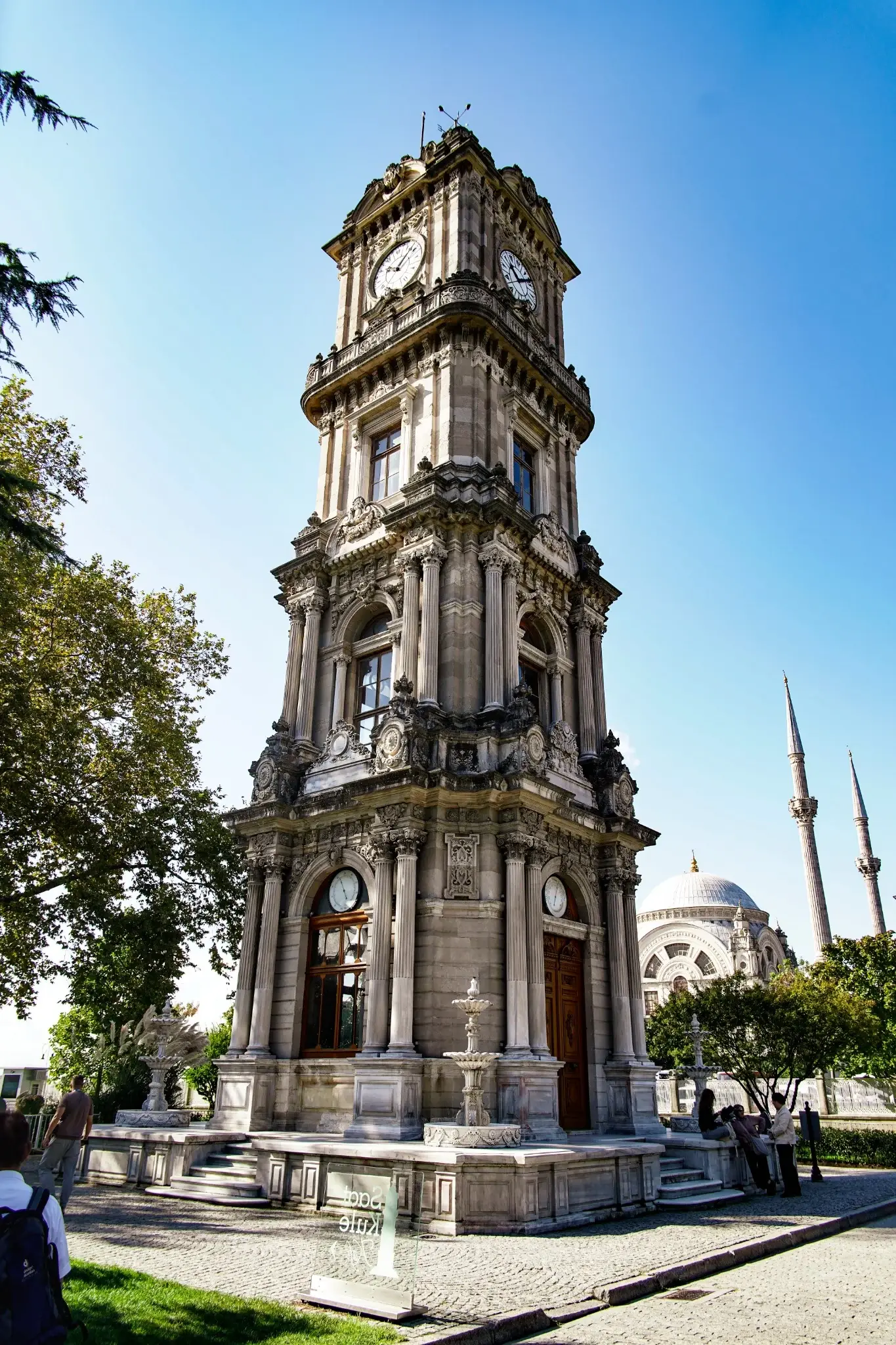
Go in by the Clock Tower
The visitor entrance is beside the Dolmabahçe Clock Tower on Dolmabahçe Caddesi. From there you pass through the outer gate area to security, ticket control and the gardens.
Don’t be misled by the grand gates you see from the waterfront or in photos. Most of them were built for ceremony or palace use and are not public entrances.
There is a café next to the Clock Tower if you need somewhere to wait or want a coffee before going in.
A one-way route at your own pace
You don’t need to join a guided group: individual visits are allowed, and an audio guide comes free with the ticket. It is handed out against a passport or ID, which you get back when you return the device.
Visitor flow is controlled, though. The route usually leads through the Selamlık, the state rooms where the sultan received ministers and ambassadors, up the Crystal Staircase and into the Ceremonial Hall, then on to the Harem and Room 71, where Atatürk died on 10 November 1938. Take your time in each room, because going back to an earlier one is often not possible. The Ceremonial Hall, between the state wing and the Harem, is where the great ceremonies of state were held, above all the formal greetings of the religious festivals.
Some rooms may be closed on the day for conservation or official use, and you may be asked to wear shoe covers on parts of the route to protect the carpets.
How long to allow
An hour to an hour and a half covers the essentials: the Selamlık, the Ceremonial Hall and the highlights of the Harem. Most first-time visitors should allow two to three hours for the full route and a walk in the gardens.
The National Palaces Painting Museum, in the former Crown Prince’s Apartment, is included in the standard ticket but is a separate walk from the main building. Add at least another hour for it: its galleries hold Ottoman and European paintings, from court portraits and Istanbul views to naval scenes and Orientalist works.
Also count on time for security, which can take up to 30 minutes in high season. Arrive between 09:00 and 10:30 on a weekday for the calmest visit. The ticket offices sell until 17:00, but some sections can stop admitting visitors earlier, so don’t leave it to late afternoon.
Bags, photos and the house rules
Travel light. Large backpacks and suitcases are not practical, and you shouldn’t count on luggage storage. Food and drink stay outside the palace rooms, and strollers may be restricted indoors, so a folding buggy or baby carrier is easier.
The photography rules changed in 2026. Under the rules in force since May, you may take photos inside with a phone, without flash and without holding up the flow. Other cameras are not allowed indoors. Rules can still vary by room, so follow the signs and the staff on the day.
Beyond that, the usual palace etiquette applies: stay on the marked route, don’t touch the furniture or sit on it, and keep your voice down.
Coming with children? The indoor route is long and controlled, so plan breaks before and after, and use the toilets in the visitor area before you go in. It helps to turn the visit into a game: spot the clocks, the crystal, the animals in the paintings, the monograms and the Bosphorus views.
Leave time for the gardens
The palace gardens are open to ticket holders and are a pleasure in themselves, with fountains, swans and the waterfront façade. Circulation is controlled, and some areas can be seen but not entered.
The Bosphorus façade and gates look best in the softer morning and late-afternoon light. Do the interiors first, though, and keep the gardens for afterwards. Picnics and drones are not allowed.
Getting there, and what to combine it with
The easiest route is the T1 tram to Kabataş, the last stop, followed by a 10–15 minute walk along the waterfront towards Beşiktaş. From Taksim, the F1 funicular runs down to Kabataş. From the Asian side, take a ferry to Beşiktaş or Kabataş; the walk from either pier is about the same.
Taxis and buses work too, but traffic along this stretch is heavy at rush hour and on match days at the nearby stadium. If you take a taxi, ask for “Dolmabahçe Sarayı, Saat Kulesi girişi”. There is no large visitor car park.
Because Topkapı closes on Tuesdays and Dolmabahçe on Mondays, both are open from Wednesday to Sunday, and the T1 tram links them. Doing both in one day is tiring, though. In Beşiktaş itself, Yıldız Palace sits on the hill above the waterfront (closed on Wednesdays), and the Ihlamur Pavilions are close by (closed on Mondays).