The Topkapı Harem: What It Was, What You See Today and Whether It Is Worth the Ticket
Not a pleasure garden but a household with its own rules, ranks and schools. What the Harem of Topkapı really was, the rooms you walk through today, and whether the separate ticket earns its place in your day.
Published
A household, not a legend
Harem means a private, protected space. At Topkapı it was the residential quarter of the sultan’s family and of the people who served them: the sultan himself, his mother the Valide Sultan, his consorts, the princes and princesses, female attendants and trainees, and the eunuch officials who guarded the doors.
It was not a place of idle luxury. It was a royal residence, a school and a tightly run institution with its own administration, routines and ceremonies. At its head, after the sultan, stood the Valide Sultan, who ran the household and could carry real influence through her access to her son.
How the household was organised
Rank decided almost everything: where you slept, what you did, how you dressed and which doors you could pass. Senior consorts had their own rooms and attendants. Princes were raised under close supervision and taught religion, language, literature, history and court protocol; princesses were educated too, and often married into the upper ranks of the Ottoman administration.
Many of the women who served in the Harem entered the palace through the Ottoman system of enslavement, and that history belongs in any honest account. Inside, they were trained in language, religion, etiquette, music, embroidery and household management, and moved up a clear hierarchy. Many were eventually freed and left the palace through arranged marriages.
The Black Eunuchs, themselves part of that system of slavery, guarded the entrances and carried messages between the Harem and the rest of the palace. Their chief, the Darüssaade Ağası, had direct access to the sultan.
A palace within the palace
The Harem was not built in one go. It grew at Topkapı from the sixteenth century onward as sultan after sultan added rooms, apartments and courtyards. That is why it feels like a maze: a narrow passage suddenly opens onto a tiled chamber, a small courtyard or a terrace with a view.
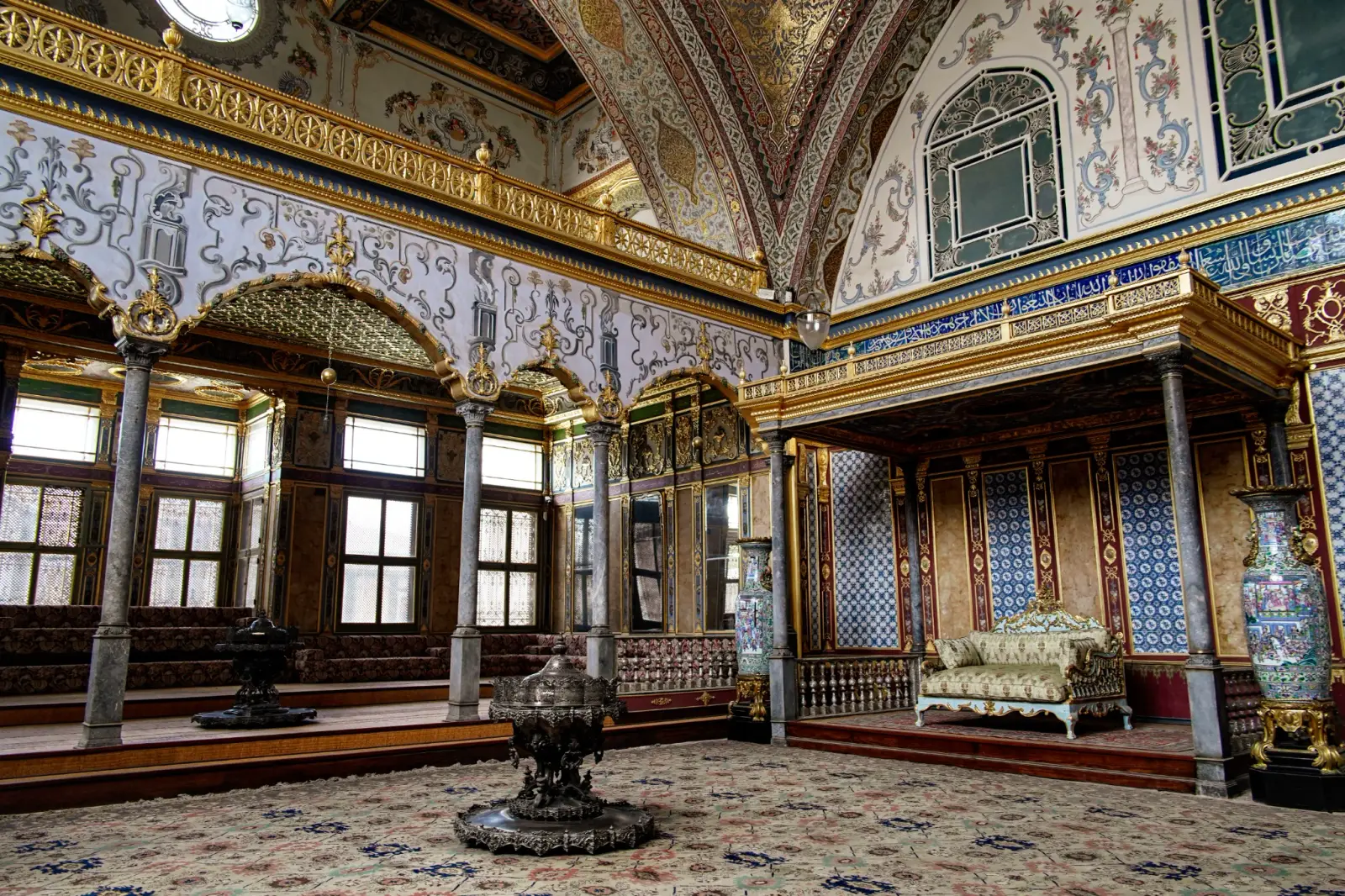
You can read the centuries on the walls. Classical İznik tiles and carved wooden doors sit next to later Baroque and Rococo decoration. Service areas are plain and practical; the apartments of the Valide Sultan and the sultan are covered in tiles, inscriptions, stained glass and gilding. The architecture itself tells you who ranked where.
What you walk through today
You enter from the Second Courtyard through the Gate of Carts and pass into the long, narrow Courtyard of the Black Eunuchs, lined with the quarters of the men who controlled access. The apartments of the Chief Black Eunuch sit close to the entrance, a little grander than the rest.
Next comes the Courtyard of the Concubines and Consorts, the centre of everyday life. The restored areas around it, with a bath, laundry, kitchen, pantry, coffee hearth and living quarters, show the practical side of the palace that the grand rooms hide.
Then the route reaches the heart of the dynasty: the apartments of the Valide Sultan, with İznik tiles and later painted decoration, and the adjoining marble baths of the sultan and his mother. Beyond them is the Imperial Hall, the largest and most ceremonial room of the Harem, with its high dome and raised seating, used for family gatherings and celebrations.
Three rooms are worth slowing down for. The Privy Chamber of Murad III, built in the late sixteenth century, is one of the finest classical Ottoman interiors to survive, with its tiles, dome and marble fountain. The smaller chamber of Ahmed I is lined with floral İznik panels. And the Fruit Room of Ahmed III, painted with fruit bowls, vases and flowers in the spirit of the Tulip Era, is a burst of colour after all that formal tilework.
The route also takes in the Twin Kiosk and the princes’ apartments, the bright Courtyard of the Favorites overlooking the gardens, and the Golden Road, a long, surprisingly plain corridor that tied the Harem together, with the Kuşhane kitchen beside it. Rooms close from time to time for conservation, so the exact route can change.
Beyond the Orientalist fantasy
For centuries European painters and travellers imagined the Harem as a world of indulgence. Most of them never set foot in one. Walking through it corrects the picture: this was a privileged home, but also a place of discipline, work, schooling and strict hierarchy, bound up with a system of enslavement. Seeing both sides is what makes the visit meaningful.
Is the separate ticket worth it?
For most visitors, yes. The courtyards and state rooms show how the empire was governed; the Harem shows how the dynasty lived. Without it, Topkapı is a palace with its private half missing.
The Harem is ticketed separately from the main palace. At the ticket office in the First Courtyard you can buy it on its own or as part of the combined ticket that also covers Hagia Irene. Müzekart and the museum passes do not cover it. Whatever ticket you hold, check that the Harem is listed on it before you go. The entrance is in the Second Courtyard, near the Imperial Council and the Tower of Justice.
Allow 45 to 60 minutes. Go early: the corridors are narrow, the rooms small, and crowds build fast. Strollers are hard going, and the floors have steps and thresholds. If you only have an hour for all of Topkapı, skip it; if you have half a day, don’t.