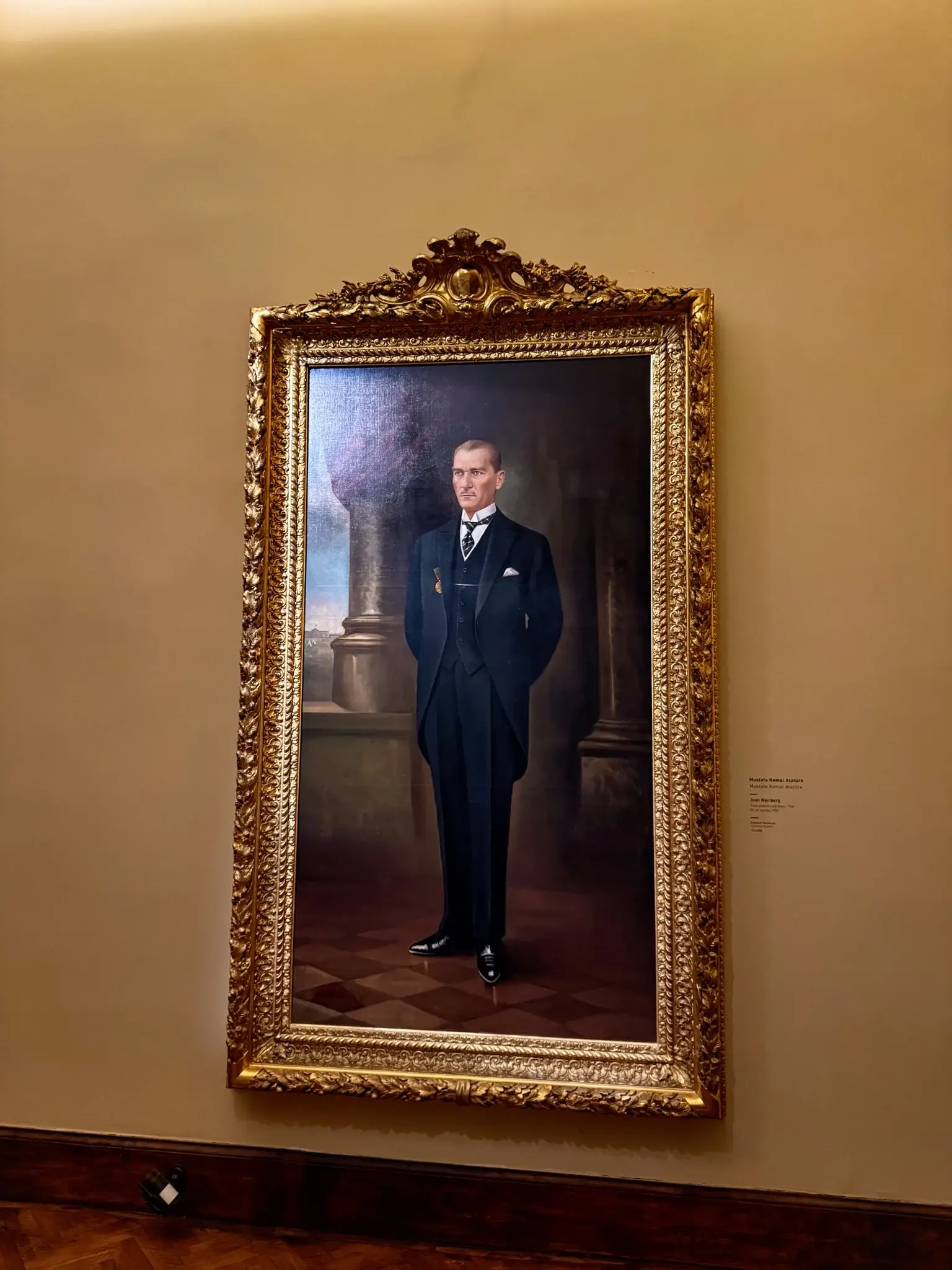
Atatürk and Dolmabahçe: the palace where the Republic’s founder died
Mustafa Kemal Atatürk stayed at Dolmabahçe on and off from 1927 and died there on 10 November 1938 at 09:05. What happened in the palace, what you see in Room 71 today, and how the day is marked.
Published
Most visitors come to Dolmabahçe for the gilded halls and the Bosphorus views. Many Turkish visitors come for one room. In the Harem wing is the small bedroom where Mustafa Kemal Atatürk, founder of the Turkish Republic, died on the morning of 10 November 1938.
The palace built for the Ottoman sultans thus became, within a few decades, one of the most important places of memory of the Republic that replaced them. This article covers his years here, the room itself, the clock that still reads 09:05, and what happens at the palace every 10 November.
Back in Istanbul, at the sultans’ palace
Atatürk left Istanbul in 1919 to organise the War of Independence and ran the new state from Ankara. He did not come back for eight years. On 1 July 1927 he arrived by sea aboard the Ertuğrul yacht and was received at Dolmabahçe, the palace that had housed the last sultans and, until 1924, the last caliph.
From then until 1938 the palace was his Istanbul base. He used it intermittently, mostly in the summer months, as a place to work and to receive foreign statesmen. According to the National Palaces administration, his stays add up to about four years in total.
The palace also hosted two of the defining events of the early Republic’s cultural programme: the First Turkish Language Congress, from 26 September to 5 October 1932, and the Second Turkish History Congress, from 20 to 25 September 1937. The opening day of the 1932 congress, 26 September, is still celebrated in Türkiye as Language Day. After the Republic took over the former imperial residences as national palaces, Dolmabahçe had become the new state’s showcase in Istanbul.
Room 71
Atatürk’s study and bedroom lie on the upper floor of the former Harem wing, on the sea side, beyond the rooms of the sultan’s mother. The bedroom is known as Room 71. It is modest in size compared with the state halls, and furnished simply.
He spent his last weeks here, ill for a long time, and died at 09:05 on 10 November 1938. Today the bed is covered with a Turkish flag. The Harem route also takes in his study and bathroom. The room is kept as it was: after maintenance work in recent years, it was reported that nothing had been changed and every object went back to its original place.
The clock that still reads 09:05
The clock in the room is kept at 09:05, the minute of his death. It is one of the details visitors look for first.
You will often hear a fuller version: that on that morning every clock in the palace was stopped at 09:05. It is a widely told story, and a moving one, but we have not found a reliable source for it. What can be said with confidence is simpler: the time in Room 71 has been kept as a memorial, and it has become part of how the whole country remembers the day.
Farewell in the Ceremonial Hall
After his death his coffin was placed on a catafalque in the palace’s great Ceremonial Hall, the Muayede Salonu, the same domed hall where sultans had received holiday greetings. From 16 to 18 November 1938 the public filed past it day and night. On the morning of 19 November the coffin was carried out of the palace on a gun carriage and taken to Ankara.
Dolmabahçe remained a presidential residence under his successor İsmet İnönü until 1949, and opened to the public as a palace-museum with its historic furnishings in 1984.
10 November at the palace today
At 09:05 every 10 November, sirens sound across Türkiye and the country stands still for a minute. Dolmabahçe is where many people most want to be at that moment, and the palace prepares for it.
The visiting rules make the day an exception. Dolmabahçe normally closes on Mondays, but on 10 November it opens even when the date falls on a Monday. Entry is free for everyone that day, and visitors follow a special route. It is also the only day on which visits in official uniform are allowed.
Expect very large crowds and long queues outside the gates. If you want to see Room 71 quietly, 10 November is not the day; if you want to share the moment with thousands of people who came for the same reason, it is.
Visiting the room on other days
Room 71 is part of the Harem, and the standard Dolmabahçe ticket covers the Selamlık, the Harem and the Painting Museum. The palace is closed on Mondays and ticket offices work from 09:00 to 17:00. You can buy at the palace, on the National Palaces e-ticket system, or through a partner; ours is dolmabahcepalacemuseum.org. The Müzekart is not valid for the Selamlık.
Inside the room, keep your voice low and take your time. It is a place of remembrance, not a photo stop. Afterwards, the Painting Museum in the former Crown Prince’s apartment has a gallery devoted to Mustafa Kemal Atatürk.