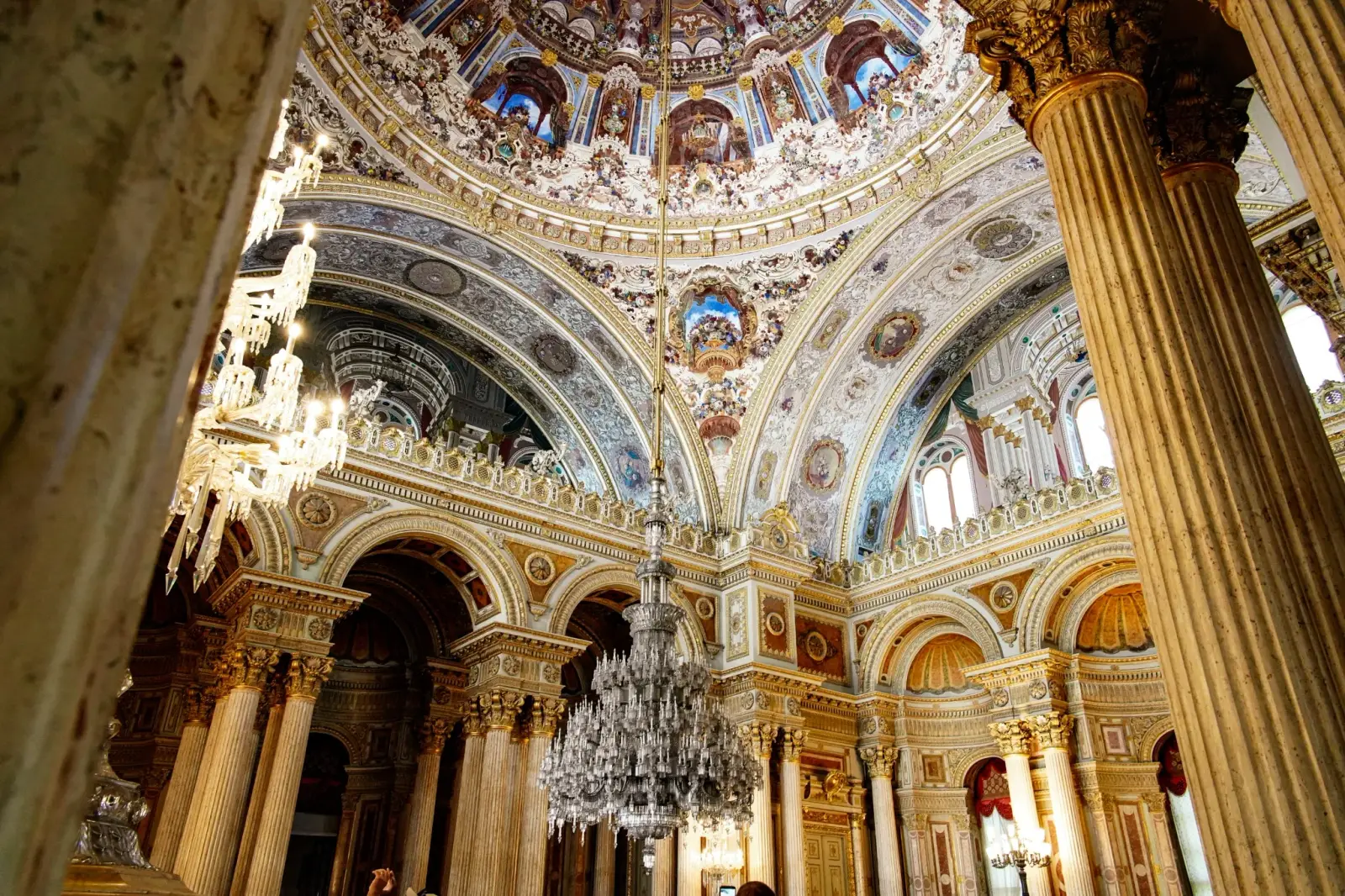
Dolmabahçe’s Ceremonial Hall and Crystal Staircase
The Selamlık was where the Ottoman state met the world, and the Ceremonial Hall was its stage. What the rooms were for, how to read them, and what is and isn’t known about the great chandelier.
Published
Dolmabahçe is one long building, but it was designed as three: the Selamlık for the state, the Harem for the dynasty’s private life, and between them the Ceremonial Hall, the Muayede Salonu. The palace opened on 7 June 1856, and from the first day its public half was built to impress. The Balyan family of architects built it; the interior decoration is credited to Charles Séchan, decorator of the Paris Opéra.
This guide follows the Selamlık route roughly in the order you walk it, and ends under the dome with the chandelier everyone photographs.
The Selamlık: where the state received the world
The Selamlık, also called the Mabeyn-i Hümâyûn, was the palace wing for government, diplomacy and the sultan’s public duties. It was not an office block in the modern sense. Every door, waiting room and salon helped express rank and control who got how close to the sultan.
You enter through the Medhal Hall, the main entrance hall. Its size makes it more than a lobby: it is the first lesson in the palace’s mix of European decoration and Ottoman protocol. From here, circulation split towards offices, waiting rooms and the grander reception rooms. The rooms near the start of the route, used by secretaries and officials, are plainer than the salons upstairs.
The Crystal Staircase
At the centre of the Selamlık, linking the ground and upper floors, is the staircase that gives the wing its best-known image. It takes its name from its crystal balusters, and the reception rooms are arranged around it.
Despite the name, it is not made entirely of crystal. The crystal elements sit alongside brass, wood, marble and a glazed roof, and the double, sweeping flight turns going upstairs into a small ceremony of its own. On a bright day, light from above sets the whole thing glittering.
Ambassadors, the Red Room and Zülvecheyn
Upstairs are the rooms where the Ottoman state did diplomacy. The sultan met foreign ambassadors in a large room on the sea side beside the Ambassadors’ Hall (Süfera Salonu). It is known as the Red Room after the colour of its decoration and furnishings, and it is one of the most lavish rooms in the palace. The matching room on the land side was set aside for the ambassador’s private talks with his own secretary.
Beyond them is the Zülvecheyn Hall. Its name means “two-sided”: it stood between the sultan’s official life and his private apartments, and between the Selamlık and the Harem. During Ramadan the palace household prayed here together.
Look at the objects as well as the architecture. Paintings, porcelain, textiles and gifts from foreign courts were part of how the empire presented itself to its guests.
The Ceremonial Hall
The Muayede Salonu separates the Selamlık from the Harem and is the monumental heart of the building. It measures roughly 25 by 37 metres; inside it is covered by a dome, outside by a roof. “Muayede” means holiday greetings: this is where the traditional greeting ceremonies of the religious festivals took place, with the sultan receiving senior officials and dignitaries. From time to time it also hosted ceremonies in honour of foreign statesmen.
Its decoration is more intense than in the rest of the palace, with gilding, painted surfaces, columns and galleries rising towards the dome, and a vast Hereke carpet made for the room. The design was also practical: separate routes let the imperial household, officials and guests arrive according to protocol without breaking the hierarchy of the occasion.
On the Bosphorus side, the largest of the palace’s five sea gates stands opposite the hall. In November 1938 the hall took on a very different role: Atatürk’s coffin lay in state here on a catafalque, and from 16 to 18 November the public filed past it day and night.
The great chandelier: what we know
The chandelier hanging beneath the dome is the palace’s most famous object, and the one with the most stories attached. The best known is that it was a gift from Queen Victoria.
That story does not hold up. In 2011 the palace’s head of lighting told the Turkish press that a document in the state archives shows the chandelier was ordered from England, arrived in Istanbul by ship in 67 crates and was installed in 1853. Its weight is usually quoted as about 4.5 tonnes, though figures vary from one publication to another.
What matters more is the effect: a single light source designed to command a room of this size and turn light itself into imperial spectacle.
Visiting the Selamlık and the hall
The Selamlık and the Ceremonial Hall are part of the main palace route, and the standard Dolmabahçe ticket covers the Selamlık, the Harem and the Painting Museum. The palace is closed on Mondays; ticket offices work from 09:00 to 17:00. Tickets are sold at the palace, on the National Palaces e-ticket system and through partners; ours is dolmabahcepalacemuseum.org. Note that the Müzekart is not valid for the Selamlık.
Individual rooms sometimes close for conservation or official use. Photography rules have changed recently, so follow the signs and staff on the day.