Four centuries at Topkapı: the palace from Mehmed II to the museum
Built after the conquest, rebuilt after fires, redecorated in the Tulip Era and left for Dolmabahçe in 1856: how Topkapı grew, and how it became the Republic’s first museum.
Published
For about four hundred years, Topkapı was where the Ottoman Empire lived and was governed. It was never finished in the usual sense: almost every generation built, rebuilt or redecorated something inside it. Walking through it today, you are walking through layers — and knowing roughly when each was laid makes the visit far richer.
A new palace on the old acropolis
After taking Constantinople in 1453, Mehmed II first lived in a palace at Beyazıt. Between 1460 and 1478 he had a second one built on the headland where the Byzantine acropolis had stood, between the Golden Horn, the Bosphorus and the Sea of Marmara. It began as gardens and pavilions inside a new circuit of walls, and it was simply called the New Palace, Saray-ı Cedîd-i Âmire, to tell it apart from the old one.
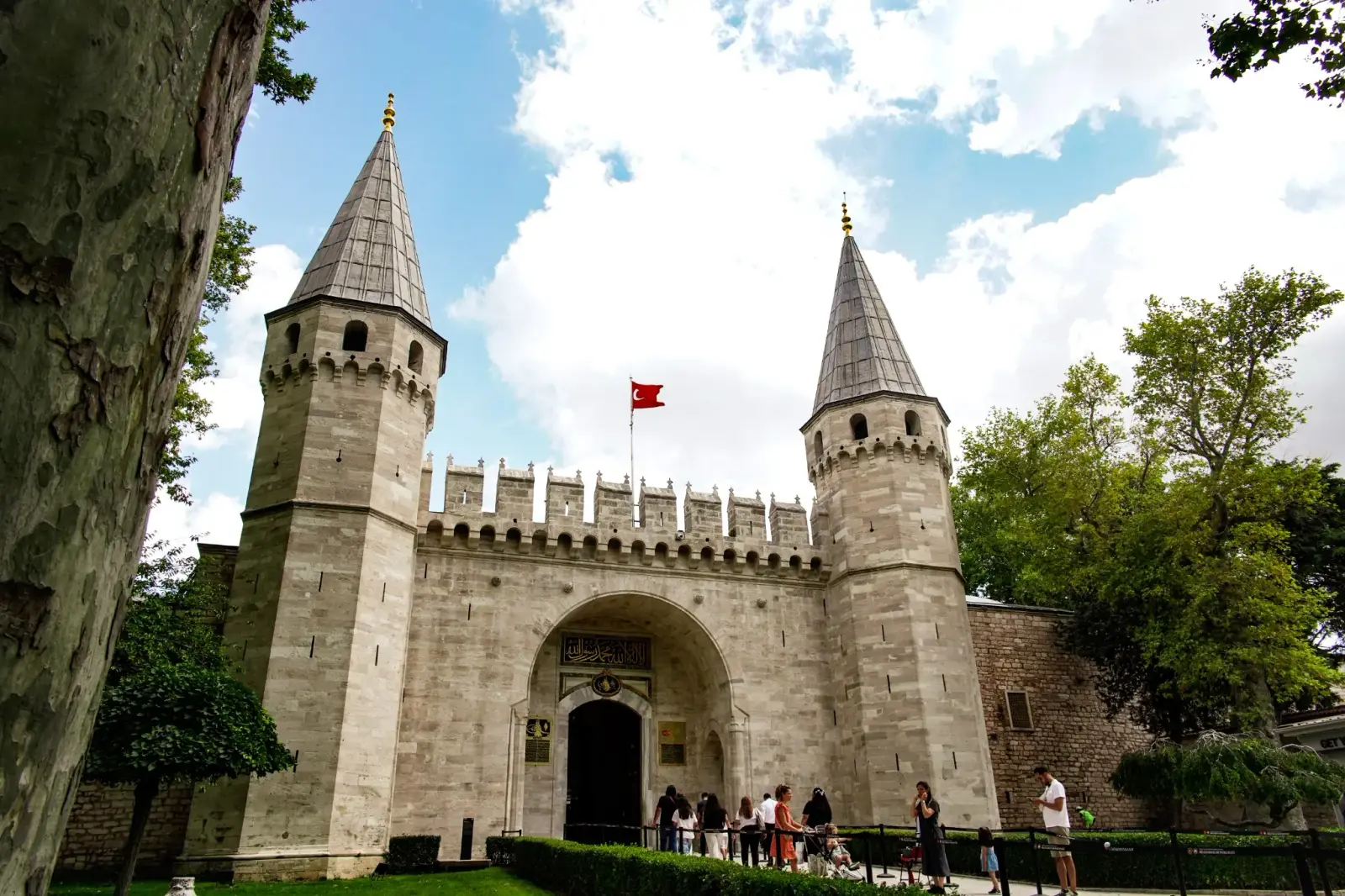
The name Topkapı, “Cannon Gate”, came later, from a gate pavilion by the sea. The inscription on the Imperial Gate carries the date 1478, and the Conqueror’s own pavilion, built around 1462–1463, still stands in the Third Courtyard as the Treasury.
From the start the palace was organised as a sequence of spaces, each more restricted than the last: the outer services, the Imperial Council where the state was run, the Enderun, or inner palace school, and finally the Harem, the dynasty’s private world.
The sixteenth century: an imperial stage
Under Süleyman the Magnificent the palace grew into the setting of a world empire. The present Imperial Council hall was built between 1527 and 1529, and the Gate of Salutation received its iron doors, dated 1524–1525. It was also in Süleyman’s reign that the women of the dynasty began to move from the Old Palace into Topkapı, and the Harem started to expand.
A little earlier, after Selim I conquered Egypt in 1517, the Holy Relics had come to Istanbul, and in time they were kept in the sultan’s Privy Chamber. In 1574 fire destroyed the kitchens, and Mimar Sinan rebuilt them with the row of chimneys that still marks the skyline. A few years later, in 1578–1579, the tiled Privy Chamber of Murad III was built in the Harem.
The seventeenth century: pavilions and fire
Murad IV commemorated his campaigns with two pavilions on the marble terrace of the Fourth Courtyard: the Revan Pavilion in 1635–1636 and the Baghdad Pavilion in 1638–1639. Under İbrahim I came the tile-clad Circumcision Room, in 1640–1641.
In 1665 a fire swept through the Harem. Mehmed IV had it rebuilt, and when he disliked the first, timber repairs, he ordered masonry instead. Turhan Sultan, his mother, played a part in the work, and many Harem rooms carry inscriptions dated 1666–1669 — much of the Harem you walk through today dates from this rebuilding.
The Tulip Era
The Treaty of Passarowitz in 1718 opened twelve years of peace, known today as the Tulip Era. It was the reign of Ahmed III and the long grand vizierate of Nevşehirli Damat İbrahim Pasha, and a time of new contacts with Europe. The name itself is later; chroniclers of the day did not use it.
Topkapı still shows the period well. In 1719 Ahmed III built the white-marble library in the middle of the Third Courtyard to gather the palace’s scattered manuscripts. The painted Fruit Room in the Harem belongs to his reign, and in 1726–1727 the core buildings of the Imperial Mint went up in the First Courtyard. The era ended abruptly in 1730, when the Patrona Halil revolt brought about Ahmed III’s deposition.
Rococo, reform and the move to Dolmabahçe
European fashions kept arriving. In 1774 Mustafa III had the Gate of Felicity redecorated in the rococo style, and Mahmud II gave the Tower of Justice its upper pavilion in 1825. In 1839 the Tanzimat reform edict was proclaimed in the palace’s outer gardens at Gülhane, today a public park.
By then the old palace no longer suited the court’s ceremonial needs. Abdülmecid built Dolmabahçe on the Bosphorus between 1843 and 1856 and moved the imperial household there in 1856. The Mecidiye Pavilion, one of the last additions to Topkapı, is also his. That same year, 1856, fire damaged the Audience Chamber in the Third Courtyard; most of its tiles and woodwork were lost, and what you see is the result of later repairs.
Topkapı was not abandoned. The Holy Relics, the Treasury and part of the palace staff stayed on, and it kept its ceremonial role until the end of the empire; the sultanate itself was abolished in 1922.
3 April 1924: the first museum of the Republic
On 3 April 1924, at Mustafa Kemal’s request, the Council of Ministers decided to turn Topkapı into a museum — the first museum of the new Republic. Since 2019 it has been administered by National Palaces. Today it covers about 350,000 square metres, not counting Gülhane Park.
If you visit both palaces, go to Topkapı first and Dolmabahçe second: you will see the story in the order it happened.