The Chamber of the Holy Relics at Topkapı: History, What You See and How to Visit Respectfully
The Prophet’s Mantle, the keys of the Kaaba, swords of the first caliphs and the sound of the Quran being recited. What the Holy Relics chamber at Topkapı is, how the relics came here, and how to dress and behave inside.
Published
A private chamber that became a shrine
The Holy Relics are not in a building of their own. They are kept in the Privy Chamber, the Has Oda, in the north-western corner of the Third Courtyard. The building belongs to the earliest core of the palace, built under Mehmed II in the late fifteenth century, and it began life as the sultan’s private residence, throne room and bedroom, looked after by the elite pages of the inner palace.
Its purpose changed once the relics arrived. By the reign of Mahmud II in the early nineteenth century the whole building had been given over to them, and it became known as the Chamber of the Blessed Mantle, the Hırka-i Saadet Dairesi. For many visitors it is still the most solemn place in the palace.
Don’t confuse it with the Treasury nearby. The Treasury is about the dynasty’s wealth, power and ceremony; the Holy Relics are not presented as a display of riches but as a place of religious and historical meaning, and visitors are expected to behave accordingly.
How the relics came to Istanbul
Most of the relics reached Istanbul after Selim I’s conquest of Egypt in 1517. The most revered of them, the Blessed Mantle, is a black woollen cloak that the Prophet Muhammad is said to have given to the poet Ka‘b ibn Zuhayr after he recited an ode in his presence. It came to Istanbul together with the keys of Mecca and other sacred objects, which the Sharif of Mecca had sent to Cairo as a sign of allegiance to the sultan.
Other pieces joined the collection over the following centuries. The Ottoman sultans treated the Mantle as a symbol of the caliphate and guarded it with great care. It is not the same garment as the Hırka-i Şerif kept in the Hırka-i Şerif Mosque in Fatih, which Abdülmecid built in 1851 and which is opened to the public during Ramadan.
The Ramadan visit
For centuries the Mantle was shown only once a year. On the fifteenth day of Ramadan the sultan and the leading men of the state came to pay their respects to it. The preparations began three days earlier: the relics were moved aside, the rooms were swept and washed with rose water, and incense was burned.
On the day, the sultan himself opened the chest that held the Mantle, wrapped in layers of silk, while imams and muezzins recited the Quran. At the end he put it back, and it stayed closed until the next Ramadan.
If the fifteenth fell on a Friday, the visit moved to Saturday. From the reign of Mahmud II, muslin cloths inscribed with verses in praise of the Mantle were touched to it and handed out to those present, and on the day trays of baklava were sent to the Janissaries.
What you see inside
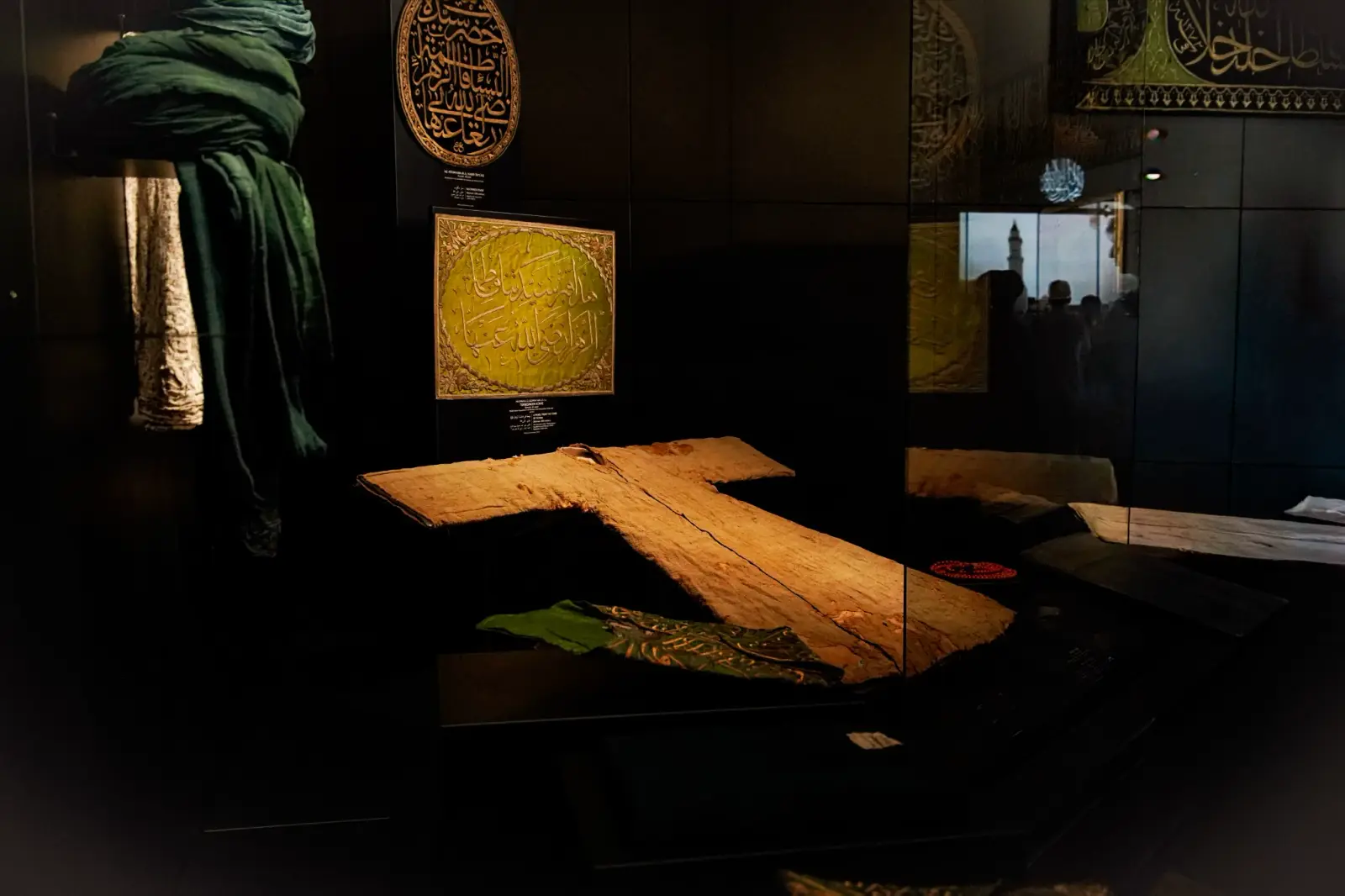
You enter through a doorway bearing calligraphy by Ahmed III into the Fountain Hall, the Şadırvanlı Sofa, a domed room with a marble fountain. Here are objects from the Kaaba in Mecca: a door, the golden rain gutter, keys and locks, and the casing of the Black Stone, alongside swords associated with the Prophet’s Companions.
The rooms beyond, clad in İznik tiles and bands of Quranic calligraphy, hold the relics associated with the Prophet: a seal, letters, a footprint, hairs from his beard, a fragment of a tooth said to have been broken at the Battle of Uhud, his swords and bow. Swords attributed to the first four caliphs, Abu Bakr, Umar, Uthman and Ali, are displayed too.
The Mantle itself rests in a gold-embellished silver chest beneath a silver-latticed canopy and is not normally displayed openly. The collection also includes objects traditionally attributed to earlier prophets, among them a staff associated with Moses.
The sound of recitation
The first thing many visitors notice is not an object but a voice. In Ottoman times the attendants of the Has Oda kept watch and recited the Quran in turns, a tradition associated with Selim I. Today, too, you hear the Quran recited live beside the relics, day and night.
It is worth pausing to listen. For Muslims visiting the palace this is a devotional moment, not a museum stop, and the calm of the rooms depends on everyone keeping their voice down.
Dress and conduct
The palace’s visiting rules say that everyone, men and women alike, must be covered as a sacred place requires before entering this section, and visitors who are not will not be let in. In practice, dress as you would for a mosque. If you are coming in summer clothes, carry something to cover up with.
Inside, speak quietly or not at all, keep moving so others can see the cases, and follow the signs and staff instructions, including on photography. The chamber is part of the main palace route, so no extra ticket is needed. Some interior sections can stop admitting visitors before the palace grounds close, so don’t leave it to the end of your day.